Affiliate & Professional Services Disclosure: BuyKoreaNow independently analyzes tax, legal, and operational infrastructure for global operators. When you engage advisory services through our bilingual Seoul partner network, we may receive a standardized referral fee at zero additional cost to you. Full methodology details are logged in our Editorial Methodology.
⚡ 30-Second Bottom Line: The F-1-D 183-Day Tax Reality
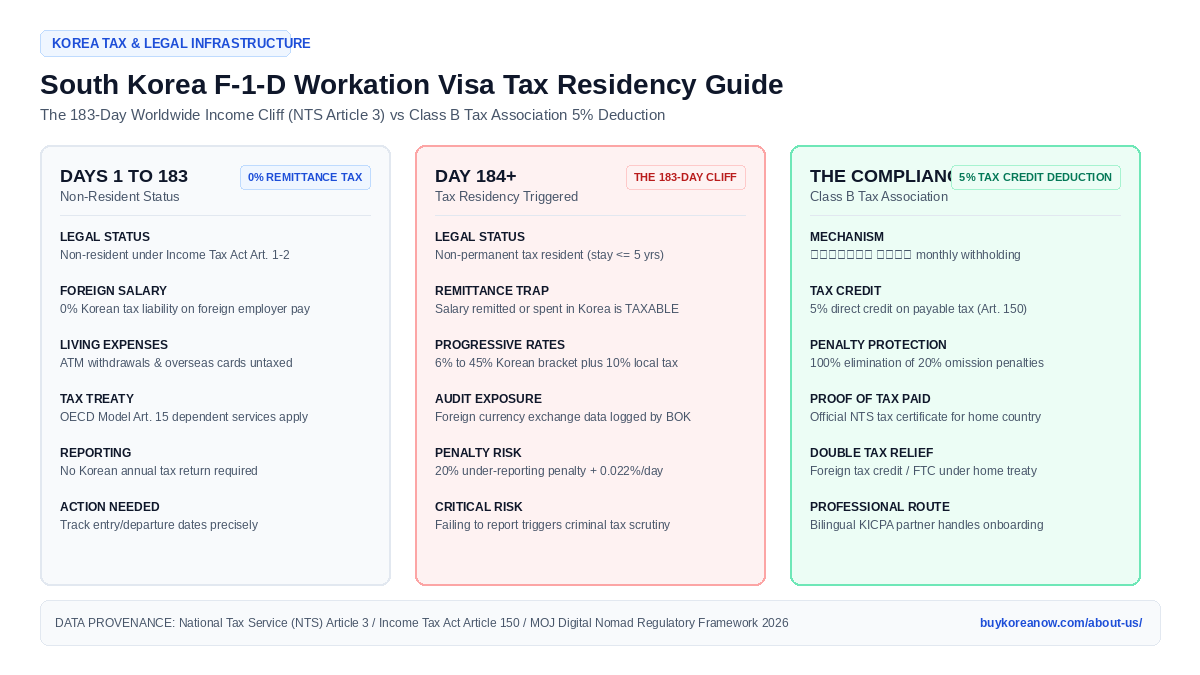
Under South Korea’s Income Tax Act Article 1-2 and Article 3, foreign remote workers residing in Korea for 183 days or more in a consecutive 12-month period automatically become tax residents. While classified as non-permanent residents (stays under 5 years), any foreign employer salary remitted to or spent in South Korea (via wire transfers, local ATM cash withdrawals, or foreign credit card living expenses) is legally taxable under progressive Korean income tax rates (6% to 45%). Unreported salary incurs a statutory 20% under-reporting penalty plus daily interest. Remote workers can legally eliminate omission penalties and secure a 5% direct income tax credit by voluntarily enrolling in a Korean Class B Taxpayers’ Association (을종근로소득 납세조합) under Article 150.

1. The Regulatory Context: South Korea F-1-D Digital Nomad Visa
South Korea’s Ministry of Justice (MOJ) officially regularized the F-1-D Digital Nomad (Workation) Visa, establishing a formal legal pathway for foreign remote tech workers, agency founders, and software engineers to live in Korea for up to two years (one year initial stay plus one year extension) while remaining employed by an overseas entity.
While immigration policy welcomes foreign remote talent, Korean tax law operates under entirely separate statutory authority administered by the National Tax Service (NTS). A widespread misconception among digital nomads is that holding an F-1-D visa shields overseas salary from Korean taxation. In reality, immigration visa classification does not override the statutory definition of tax residency under Article 1-2 of the Korean Income Tax Act.
2. The 183-Day Rule: How Tax Residency is Triggered (NTS Article 1-2)
Under Korean tax law, individuals are categorized as either Residents or Non-Residents:
- Non-Resident (< 183 Days): An individual who maintains no domicile in South Korea and resides in Korea for fewer than 183 days within a consecutive 12-month period. Non-residents are taxed strictly on domestic Korean-source income. Overseas salary earned from a foreign employer with zero Korean operations is 100% exempt from Korean taxation.
- Tax Resident (≥ 183 Days): An individual residing in Korea for 183 days or more in aggregate. On Day 184, your worldwide tax status fundamentally changes.
The Non-Permanent Resident Rule (Article 3, Paragraph 1)
Foreign nationals who become Korean tax residents but have resided in Korea for 5 years or less in the aggregate over the preceding 10 years are classified as Non-Permanent Residents (비영주거주자). Under Article 3 of the Income Tax Act:
“Non-permanent foreign residents are subject to Korean income tax on foreign-source income only to the extent that such income is paid within South Korea or remitted into South Korea.”
— National Tax Service of South Korea, Income Tax Act Article 3
3. The Remittance Trap: What Counts as “Remitted into Korea”?
Many remote workers believe that keeping their salary in a foreign bank account (e.g., Chase, Barclays, Wise, or Revolut) prevents Korean tax liability. However, the National Tax Service strictly enforces the economic reality of remittance:
- Direct Bank Wires: Wiring USD, EUR, or GBP from an overseas account to a Korean bank account (e.g., Shinhan, Hana, Woori, KakaoBank) is a direct, logged remittance.
- Local ATM Cash Withdrawals: Withdrawing Korean Won (KRW) from a Korean ATM using a foreign debit card qualifies as foreign income remitted to South Korea.
- Foreign Credit Card Living Expenses: Paying for Seoul rent, groceries, co-working desks, and domestic transportation using an overseas credit card is treated by NTS auditors as living expenses funded by overseas earnings and remitted into the Korean domestic economy.
The Bank of Korea (BOK) automatically logs all cross-border foreign currency transactions exceeding $10,000 annually. When foreign nomads renew their F-1-D visa or Alien Registration Card (ARC) at immigration, cross-agency data sharing allows NTS to flag extended stays lacking corresponding tax filings.
4. Statutory Comparison: Tax Exposure by Duration of Stay
| Tax Dimension | Days 1 to 183 (Non-Resident) | Day 184 to Year 5 (Non-Permanent) | Year 5+ (Permanent Resident) |
|---|---|---|---|
| Statutory Basis | Income Tax Act Art. 1-2 | Income Tax Act Art. 3 | Income Tax Act Art. 3 Full Scope |
| Foreign Salary Liability | 0% (Fully exempt) | Taxable on remitted/spent amounts | 100% Taxable worldwide |
| Applicable Tax Rates | N/A (Zero Korean filing) | Progressive 6% to 45% (+10% local) | Progressive 6% to 45% (+10% local) |
| Under-Reporting Penalty | None | 20% of unpaid tax + 0.022%/day | 20% to 40% + 0.022%/day |
| Tax Association Credit | N/A | 5% Direct Credit (Art. 150) | 5% Direct Credit (Art. 150) |
| Annual Filing Deadline | None | May 1 – May 31 (Global Return) | May 1 – May 31 (Global Return) |
5. The Compliance Shield: Class B Taxpayers’ Association (을종납세조합)
Because your foreign employer has no legal entity, branch, or Permanent Establishment (PE) in South Korea, they cannot withhold Korean income tax at source on your behalf. This is where Korean tax law provides a specialized statutory mechanism known as the Class B Taxpayers’ Association (을종근로소득 납세조합).
Under Article 150 of the Income Tax Act, foreign workers earning Class B wage and salary income can voluntarily organize or join an authorized Class B Tax Association. The association calculates your progressive Korean income tax, files monthly withholdings with the competent district tax office, and issues official NTS tax payment certificates.
The 5% Tax Credit Incentive (Article 150, Paragraph 3)
To encourage voluntary compliance by foreign employees of overseas firms, the Korean government grants a statutory 5% direct tax credit deducted straight from your payable income tax. Furthermore, filing through a Class B Tax Association satisfies your monthly withholding obligations, completely eliminating the 20% omission penalty and protecting your clean immigration record for visa renewals and permanent residence transitions.
6. Double Taxation Relief: Protecting Your Home Country Position
South Korea maintains bilateral double taxation treaties with over 90 jurisdictions, including the United States, United Kingdom, Canada, Australia, Germany, and Singapore. Under standard OECD Model Treaty Article 23:
- Taxes paid to the Korean National Tax Service through your Class B Tax Association qualify for a Foreign Tax Credit (FTC) on your home country tax return (e.g., IRS Form 1116 for US citizens or HMRC Foreign Income for UK nationals).
- You do not pay double tax; the tax paid in Korea directly offsets your home country tax liability dollar-for-dollar up to treaty limits.
- Obtaining certified NTS Certificates of Tax Payment (납세증명서) is mandatory to claim these treaty credits, which our bilingual accounting partners prepare directly in English.
7. Practical Step-by-Step Action Plan for Remote Workers in Seoul
- Audit Your Cumulative Days: Calculate your exact physical days in South Korea across any rolling 12-month window. Entry and exit dates both count toward the 183-day threshold.
- Map Your Remittance Footprint: Review your monthly living expenses transferred into Korea, ATM cash withdrawals, and card expenditures.
- Consult a Bilingual KICPA Tax Specialist: Prior to reaching Day 180, schedule a structured consultation with an English-speaking Korean Certified Public Accountant to review treaty provisions.
- Enroll in a Class B Association: If your planned stay exceeds 183 days, enroll in an authorized Class B Taxpayers’ Association to lock in your 5% tax credit and establish zero-penalty compliance.
💼 Schedule a Confidential 1:1 Korean Tax Residency Review
Navigating Korean tax brackets, foreign remittance calculations, and Class B Tax Association enrollment requires accredited local expertise. BuyKoreaNow connects foreign remote operators directly with licensed, bilingual Seoul KICPA accounting firms specializing in cross-border tech and nomad taxation.
Frequently Asked Questions (FAQ)
Does holding an F-1-D visa exempt me from paying Korean income tax?
No. Immigration visa categories do not override statutory tax residency under Article 1-2 of the Korean Income Tax Act. If you physically stay in South Korea for 183 days or more, you are legally a Korean tax resident regardless of whether your visa is F-1-D, tourist, or business status.
Can the Korean National Tax Service see my overseas bank account?
Under the OECD Common Reporting Standard (CRS), over 100 tax authorities automatically exchange financial account information annually. Furthermore, Korean foreign exchange regulations log all domestic ATM withdrawals, cross-border wires, and foreign credit card transactions in Korea.
How much is the Class B Tax Association deduction?
Under Article 150, Paragraph 3 of the Income Tax Act, taxpayers who report their overseas wage income through an authorized Class B Taxpayers’ Association receive an immediate 5% tax credit deducted from their final calculated Korean income tax liability.
Leave a Reply