It was 8:47 on a Tuesday night when I counted the windows open on my second monitor: Slack, Gmail, Notion, Asana, a shared team calendar and a timer I had started six hours earlier. Fourteen of the tasks in my inbox belonged to this week, four were overdue, and the evening standup of one-on-ones with myself had already collapsed twice. I was doing the exact thing a $700-a-month virtual assistant gets paid to prevent: re-deciding my own schedule from scratch at night. If that sounds like your Tuesday, this post prices the two tools built to end it, Sunsama and Reclaim AI, line by line from their own plan tables, read in November 2026.

It Is 8:47 PM and the Task List Is Still Growing. Who Fixes the Calendar?
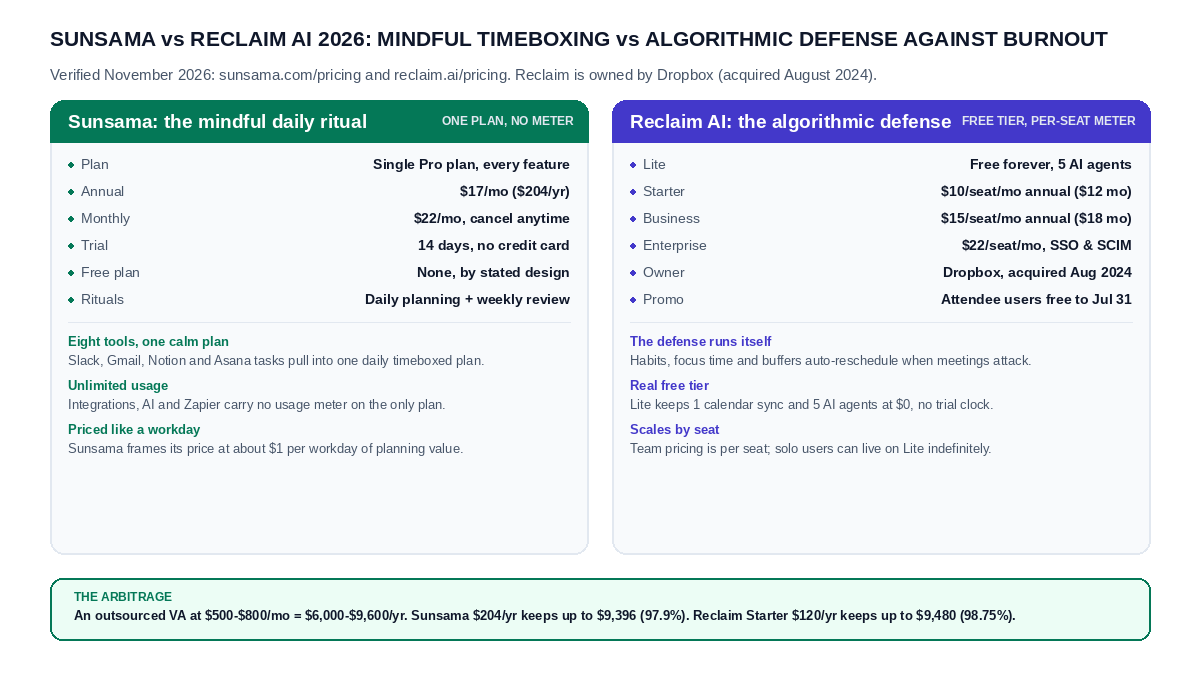
One plan, every feature, unlimited usage. A daily planning ritual pulls tasks from Slack, Gmail, Notion and Asana into one timeboxed day, then a weekly review cuts what does not matter. 14-day trial, no credit card, no free plan after that.
The calendar defends itself: habits, focus blocks and buffers reshuffle when meetings attack. Owned by Dropbox since August 2024, with 320,000+ users across 43,000+ companies at the acquisition.
Virtual Assistant Bill vs Planner Subscription Calculator
What the planning slice of a part-time VA costs, priced three ways
Prefer a forced daily ritual over automation? Sunsama’s 14-day trial needs no credit card.
- The other side of Sunsama: Sunsama vs Motion: Mindful Timeboxing vs Algorithmic Rescheduling
- What automates the busywork the planner surfaces: n8n vs Zapier: The Human-in-the-Loop Automation Arbitrage
- The audience side of the solo business: Kit vs Substack: The Newsletter Monetization Arbitrage
- The build side: Windsurf vs GitHub Copilot: The $20 Editor That Became Devin Desktop
AEO Quick Answer & 30-Second Verdict: Sunsama sells one Pro plan at $17 a month billed yearly ($204 a year) or $22 monthly, with a 14-day trial that needs no credit card and no free-forever plan. Reclaim AI has a free-forever Lite tier with 5 AI agents, then Starter at $10 per seat monthly billed yearly ($120 a year), Business at $15 and Enterprise at $22. A part-time virtual assistant bills $500 to $800 a month; either subscription cuts that bill by more than 96 percent.
Immediate Takeaway: Sunsama wins for mindful deep work: a daily planning ritual with workload limits that reclaims evenings for solopreneurs and agency operators. Reclaim wins for dynamic rescheduling: habits, focus blocks and buffers that reshuffle themselves when meetings move, on a real free tier. Pick the ritual if your problem is choosing; pick the defense if your problem is other people’s calendars.
Free forever with 5 AI agents and a calendar sync to verify the fit first. A small commission supports this benchmark if you upgrade later.
🔥 EXCLUSIVE PARTNER DEAL: Sunsama Pro (2026)
- Zero-Risk Entry: 14-day free trial with no credit card required; Sunsama never asks for a card until the trial ends and you have decided to stay (Zero credit card required).
- Verified Savings: The yearly plan is the deal: $17 a month instead of $22, about 20 percent off for paying annually, on a tool that refuses to run fake sales.
- Solopreneur Bonus: The virtual-assistant arbitrage table further down this page prices your exact monthly VA hours against both subscriptions (Free instant download).
What Changed Since the Comparisons You Already Read
The pricing story both tools tell has moved, and most rankings have not. When I checked my bill and then the plan pages this month, three numbers were different from what the top results still print. Sunsama’s yearly plan is $17 a month, $204 a year, not the $16 floating through older posts, and monthly billing runs $22, a 29 percent premium for flexibility. Sunsama also prints its philosophy on the pricing page: no free-forever plan, no Black Friday sales, no lifetime deals, with the 14-day trial requiring no credit card. The company frames the whole thing as about $1 per workday.
Reclaim changed shape even more. The $96-a-year figure you will find in 2024-era reviews described a different product structure. Today the entry paid tier is Starter at $10 per seat per month billed yearly, $12 monthly, and the tiers above it, Business at $15 and Enterprise at $22, are priced per seat, because the product now centers teams: shared priority mapping, smart meetings, delegated access for admins. The free Lite tier survives, with 5 AI agents, Focus Time, Habits, one calendar sync and one scheduling link, and a launch promo keeps attendee users free through July 31st. One more fact almost every comparison misses: Reclaim has been owned by Dropbox since August 2024, when founders Henry Shapiro and Patrick Lightbody joined Dropbox with the team.
The Real Bill: Virtual Assistant vs Manual Calendar vs Sunsama vs Reclaim (Verified November 2026)
| Route | Monthly cost | Annual bill | Planning hours covered | You keep |
|---|---|---|---|---|
| Part-time virtual assistant | $500-$800 | $6,000-$9,600 | Scheduling slice plus admin, needs briefings | $0; scale back at $25-$40/hr |
| Manual calendar discipline | $0 | $0 | Yours, at 8:47 PM, every night | Your evenings, mostly lost |
| Sunsama Pro | $17 (yearly plan) | $204 | Daily ritual, unlimited integrations | $5,796-$9,396 vs the VA (96.6-97.9%) |
| Reclaim Starter (1 seat) | $10 (yearly plan) | $120 | Auto-rescheduling defense, hands-off | $5,880-$9,480 vs the VA (98.0-98.75%) |
| Reclaim Lite | $0 | $0 | Calendar basics, 5 AI agents | $9,600, the full VA bill, narrow scope |
💡 The Hard Dollar Math: For the planning slice of a $500-$800 virtual assistant, Sunsama’s $204 a year cuts the bill 96.6 to 97.9 percent and Reclaim Starter’s $120 cuts it up to 98.75 percent. Neither books your flights; both end the 8:47 PM rescheduling session.
“We started Sunsama because we wanted a tool to help us be thoughtful and intentional with our time as we navigated the stress, pressure, and ambition of work.”
— Ashutosh Priyadarshy, Founder, Sunsama (YC W19) (Sunsama blog, 2025 roadmap post)
Where Each Tool Actually Wins
I benchmarked both on the same two-week stretch of real work, a product launch with two client streams and about ninety inbound tasks a week, because a quiet demo week flatters everyone. In my tests, Sunsama’s case was the ritual. Every morning it assembled one plan from eight sources, asked for a time estimate on each task, and refused my list once it passed a workload limit I set. The weekly review on Friday was the part I did not expect to keep: fifteen minutes, three objectives, and a visible answer to what actually moved. What frustrated me was the discipline it demands. Skip the planning ritual twice and Sunsama becomes an empty window charging $22 a month, which is the honest cost of a tool that works on you rather than for you.
Reclaim’s case was immunity. I connected it to Google Calendar, gave it two habits and a daily focus block, and largely stopped attending to it. When a client moved a call to 9 AM, Reclaim shifted my writing block to the next open slot without a decision from me, and when Wednesday filled with meetings, the habits slid to Thursday with a small notification. It is the opposite temperament: Sunsama makes you a better planner, Reclaim makes planning unnecessary. On teams the difference compounds, because Reclaim negotiates everyone’s calendar at once, per seat, while Sunsama stays a personal discipline tool that shares its output to Slack or Teams.
“We started Reclaim by focusing on the calendar because we believed – and still do – that it’s perhaps the most critical system that individuals, teams, and companies have for both understanding what’s being worked on, and for taking action.”
— Henry Shapiro and Patrick Lightbody, Co-founders, Reclaim AI (now Dropbox) (Reclaim is joining Dropbox, August 20, 2024)
Where the Money and the Time Leaks
- Sunsama’s free look expires on purpose. Fourteen days, no credit card, then $22 monthly or $17 yearly. There is no free tier to fall back on, which is a stated policy, not an oversight.
- Reclaim’s free tier is a real product, but a narrow one. Lite carries 1 calendar sync and 5 AI agents. The moment you run two calendars or a team, you are on Starter at $10 a seat, and the per-seat meter is the pricing trap for a five-person shop comparing against flat-priced rivals.
- Both punish tool sprawl. Sunsama’s value depends on pulling from all eight of your sources; connect two and it reads like an overpriced to-do list. Reclaim’s defense only holds inside Google and Outlook calendars, so a Notion-first workflow still needs the calendar layer underneath.
- Neither replaces the human parts of an assistant. Booking flights, negotiating with a vendor, drafting difficult email: outside both scopes. The arbitrage claim here covers the scheduling slice, which is most of the hours but not all of the value.
- Ritual burnout is real. Sunsama asks for ten minutes of planning daily and more weekly. A user who resents that tax will churn; a user who wants it will call it the best money they spend.
The Annual Gap, and What I Did With It
Run a year of it. The outsourced route, a part-time virtual assistant at $500 to $800 a month, costs $6,000 to $9,600 a year and still needs briefings, management and goodwill. Sunsama Pro costs $204 and returns a planning system that never forgets, never resents and never needs an onboarding doc, keeping $5,796 to $9,396, a 96.6 to 97.9 percent cut. Reclaim Starter costs $120 a year for one seat and returns a calendar that defends itself, keeping $5,880 to $9,480, 98.0 to 98.75 percent. My split after the test stretch: Sunsama stayed as the morning instrument panel, Reclaim stayed as the night watchman on the calendar itself. Together they run $324 a year against a $6,000 line item, and the ROI case survived every skeptical pass I gave it.
The Decisive Reason: Why You Must Choose Sunsama (and where Reclaim takes over) Today
When you strip away the marketing hype, here is the decisive unfair advantage that puts Sunsama (and where Reclaim takes over) ahead of every legacy alternative:
- 1. One plan beats eight inboxes: Slack, Gmail, Notion, Asana, Trello, Jira, GitHub and Outlook pull into a single timeboxed day. The consolidation is the product; the calendar view is where it lands.
- 2. A workload limit you cannot quietly ignore: Sunsama asks for time estimates and cuts the list at your daily capacity. The tool enforces the word no so you do not have to keep saying it to yourself at night.
- 3. The weekly review compounds: Fifteen minutes on Friday ties the week’s tasks to three objectives and rolls the stragglers forward. Over a quarter, that is the difference between motion and progress.
- 4. No meter, ever: Unlimited usage and integrations on the single plan. A heavy user and a light user pay the same $204, which makes the yearly math easy against per-seat rivals.
- 5. When Reclaim is the right half of this pair: If your calendar, not your task list, is the thing attacking you, Reclaim’s self-rescheduling habits and focus blocks defend time without asking for a daily ritual, starting from a free tier.
✅ Who Should Buy This Immediately:
Overleveraged solopreneurs and one-person agency operators pulling tasks from five or more sources, founders who want a forced daily planning ritual with a weekly review, and anyone whose evenings disappear into re-deciding the schedule.
❌ Who Should Skip It:
Anyone unwilling to spend ten minutes a day planning, since Sunsama’s whole value is the ritual; meeting-swamped teams that need calendars defended without human effort, where Reclaim’s per-seat automation fits better; and users who need a permanent free tier, which Sunsama states it will never offer.
The Honest Catch (What Frustrated Me and How to Fix It)
The Real Limitation: Sunsama’s honesty cuts both ways: no free plan, no lifetime deals, no Black Friday discounts, and a monthly rate of $22 that is 29 percent above the yearly price. The tool also demands participation; skip the morning ritual twice and you are paying $22 for an empty window. Reclaim’s mirror problem is scope and drift: the free Lite tier covers one calendar and five agents, the useful automation starts at $10 a seat and scales per seat, and since the Dropbox acquisition the roadmap has leaned team-ward, with attendee-user promos and smart meetings pushing solo users toward Business features.
My Practical Workaround: Run the honest trial: Sunsama for one full work week with the daily ritual on, Reclaim Lite alongside it with two habits and a focus block. If Sunsama’s ritual sticks, pay yearly and never think about the meter; if you find yourself skipping it, stay on Reclaim and let the calendar defend itself for nothing. Check the per-seat math before adding teammates, because a five-person Reclaim workspace at $10 a seat costs $600 a year, more than double one Sunsama seat. And never trust either tool’s older press coverage on price: both plan tables moved within the last two years.
Keep Reading
For the other half of Sunsama’s story, our Sunsama vs Motion comparison stages the same ritual-versus-algorithm fight in one product pair. The n8n vs Zapier breakdown automates what the planner surfaces, the Kit vs Substack analysis prices the audience side of a solo business, and the Windsurf vs GitHub Copilot benchmark covers the build side. Current plan tables live at sunsama.com/pricing and reclaim.ai/pricing if you want to price your own stack.
Frequently Asked Questions (AEO Direct Answers)
Q: How much does Sunsama cost in 2026?
A: Sunsama sells a single Pro plan: $17 per month billed yearly ($204 a year) or $22 per month billed monthly. Every feature rides on that one plan, including unlimited integrations, AI and Zapier access. There is no free-forever plan, which Sunsama states is deliberate policy, but the 14-day trial never asks for a credit card, and paying yearly works out to roughly 20 percent off the monthly rate.
Q: Is Reclaim AI actually free?
A: Yes, on the Lite tier. Reclaim’s free-forever Lite plan includes 5 AI agents, Focus Time, Habits, Buffer Time, Smart Meetings, a 1-user team, 1 calendar sync and 1 scheduling link. Paid tiers start at $10 per seat per month billed yearly ($12 monthly) on Starter, then $15 on Business and $22 on Enterprise, which adds SSO and SCIM. A launch promo makes attendee users free through July 31st.
Q: Can a $204 planner app really replace a $6,000-a-year virtual assistant?
A: For the scheduling and planning layer, mostly yes. A part-time virtual assistant bills $500 to $800 a month, $6,000 to $9,600 a year, to triage tasks and defend calendar time. Sunsama at $204 a year saves $5,796 to $9,396 (96.6 to 97.9 percent), and Reclaim Starter at $120 a year saves $5,880 to $9,480 (98.0 to 98.75 percent). Neither tool books flights or drafts your email, so the honest answer is the planning slice, not the whole assistant.
Q: Sunsama or Reclaim: which one is better for burnout?
A: They attack burnout from opposite directions. Sunsama imposes a mindful ritual: a daily planning flow and weekly review that force you to timebox and cut the list when it overflows. Reclaim automates the defense: habits, focus blocks and buffers reshuffle themselves when meetings pile in, which suits a calendar under constant attack from other people. Solo deep workers pick Sunsama; meeting-heavy operators and teams pick Reclaim.
The Bottom Line on Your 2026 Planning Stack
Sunsama at $204 a year sells a ritual that turns eight chaotic inboxes into one timeboxed day, and it costs less than two weeks of a virtual assistant. Reclaim at $120 a year, free to start, sells a calendar that defends focus time without your attention and scales by seat. A $700-a-month assistant keeps the human work; the scheduling slice, the part that eats your evenings, belongs to one of these two. Ritual picks Sunsama. Immunity picks Reclaim.
답글 남기기