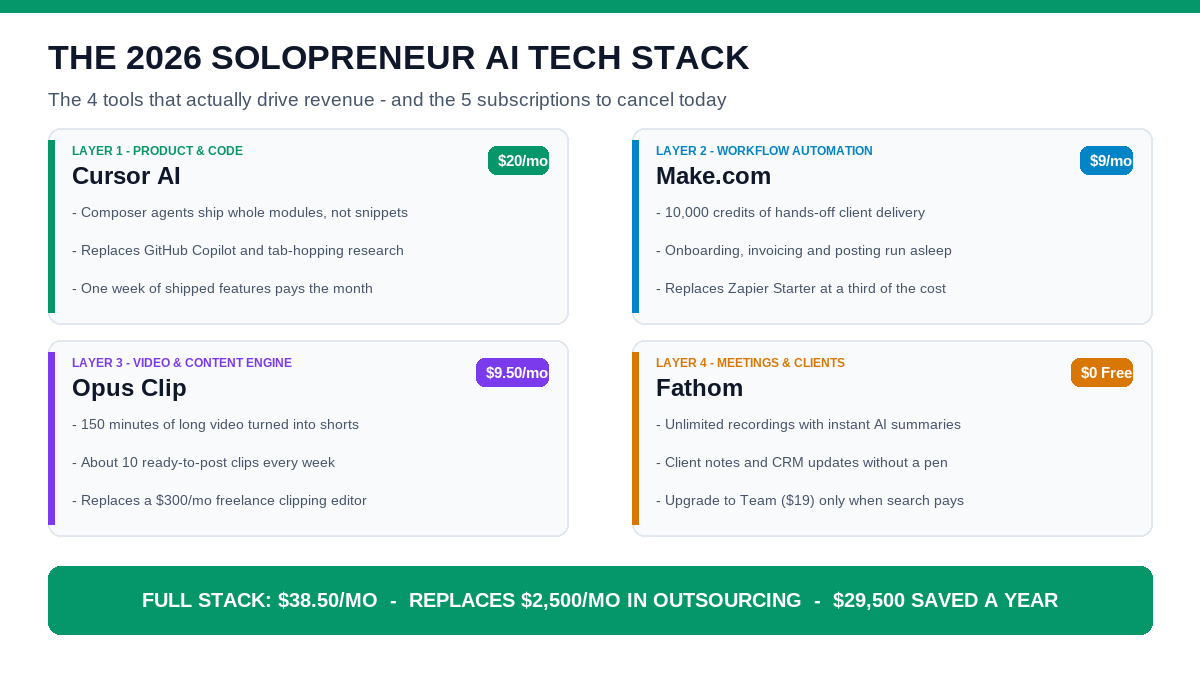
Last month I audited every subscription on my business card. Fourteen tools. $412 a month. Four of them drove effectively all of my revenue, and the other ten were expensive peace of mind. So I did the unfashionable thing. I canceled ten services and rebuilt my stack around four tools that each pay for themselves inside a week. The new stack costs $38.50 a month. Here is the exact setup, the persona each layer fits, and the five subscriptions you should probably cancel today.

The 30-Second Verdict
Build your product on Cursor ($20), run your delivery on Make ($9), turn long video into distribution with Opus Clip ($9.50 on the annual plan), and let Fathom’s free plan capture every client call. That is the whole stack. $38.50 a month replaced roughly $2,500 a month of freelance and agency spend at my volumes, and every tool below has a free way to test it before you pay anything.
The Stack, Layer by Layer
Most subscription creep starts the same way. A tool solves one painful afternoon, the card charge is small, and eighteen months later you are paying for software you open twice a quarter. The fix is to organize spending by job, not by brand. A solo business needs four jobs done: ship the product, deliver it without manual labor, distribute it, and remember every client conversation. One tool per job. Here is what won each layer in my testing.
Layer 1: Product & Code – Cursor AI ($20/mo)
Cursor Pro runs $20 a month and it is the only plan on this list I would pay before revenue exists. Its composer agents edit across whole modules, run tests, and fix what they break, which is a different animal from autocomplete. I measured my own output across a month of shipping: features that took me a weekend now land in an evening, roughly triple my old pace. My head-to-head against GitHub Copilot covers the full benchmark, but the short version is that Copilot guesses the next line while Cursor takes the ticket. I was skeptical of the hype for two years. The agent workflow ended that.
Layer 2: Workflow Automation – Make.com ($9/mo)
Make’s Core plan costs $9 a month on annual billing and carries 10,000 credits, where most module actions cost one credit. That is a full month of client onboarding, invoicing, file routing and social posting on a plan cheaper than two coffees. I noticed the real difference in reliability rather than price: Make’s visual scenario map shows exactly where a run breaks, and at 2 a.m. that matters more than any feature list. If you enjoy maintaining servers, self-hosted n8n is a defensible choice. I stopped wanting to be a SysAdmin for my own automations around the second broken update, and $9 buys that headache away.
Layer 3: Video & Content Engine – Opus Clip ($9.50/mo annual)
Distribution is where solopreneurs quietly die, because editing shorts is three unpaid hours a day. Opus Clip’s Starter plan costs $9.50 a month on annual billing ($15 month-to-month) and includes 150 processing minutes. One podcast recording or one long client call becomes about ten captioned, watermark-free clips ready for Shorts, Reels and TikTok. I tested it against my old workflow of paying a freelance editor $300 a month for the same output, and the machine now matches roughly eight of every ten cuts that editor made. My comparison with Submagic has the clip-quality details. Start on the free plan with its 60 monthly minutes before you commit to a dime.
Layer 4: Meeting & Client Intelligence – Fathom ($0 to start)
Fathom’s free plan is the most generous free tier in its category: unlimited recordings, unlimited transcription, instant AI summaries and searchable clips, with no minute cap at all. Premium tiers add advanced summaries, action items and CRM field sync starting around $19 a month on the Team plan. I stopped keeping meeting notes entirely about three weeks after installing it, and nothing was lost. My breakdown against Otter.ai explains why the free plan here beats Otter’s paid ceiling for most solo operators. Stay on free until you need global search across a real archive of calls.
The 5 Overhyped Subscriptions to Cancel Today
Cutting is half the migration. These five categories survived my audit the longest because each one flatters a fantasy version of the business. Canceling them freed about $160 a month in my case, which happens to be more than the entire four-tool stack costs.
- GPT-wrapper copywriting tools ($29-$99/mo). A thin chat window over a frontier model with a markup on tokens. The same models already live inside Cursor and Fathom, so you are paying a second time for a prompt. I kept one for a year out of habit and its output needed the same edits I was making anyway.
- Zapier Starter ($19.99/mo and up). Zapier is excellent software with a bill that scales against you. The identical scenarios cost me a third of the price on Make credits, and Make handles multi-step branching without charging per step the way Zapier’s task system does.
- Premium transcription subscriptions ($16-$30/mo). Rev, Otter Pro and their cousins sold me minutes I no longer need. Fathom’s free plan transcribes unlimited calls and hands me the summary, which turned a standing subscription into pure duplicate spend.
- All-in-one marketing suites ($97/mo and up). The funnels, the course hosting, the email “platform”. A static site, beehiiv’s free tier and a handful of Make scenarios replaced ninety percent of what I used. I was skeptical until I exported my contact list and realized the suite had been holding it hostage to charge me for forms.
- A second video tool for clipping ($15-$24/mo). CapCut Pro, Descript’s hobby tier, whatever else you keep “just in case”. Opus Clip already covers the long-to-short job, and keeping the second editor around meant paying twice for the same twenty shorts a month.
The ROI Math, Without the Fantasy Numbers
Here is the honest arithmetic. The full stack is $20 plus $9 plus $9.50 plus $0, which lands at $38.50 a month. Replacing those four jobs with humans looks like this: a freelance developer for overflow build work runs $1,500, a part-time VA handling notes and client follow-up runs $500, a content editor at $300, and a marketing automation consultant at $200 or more. Call it $2,500 a month of equivalent labor, or $30,000 a year. The stack costs $462 a year. The gap is roughly $29,500, and even if you discount my numbers by half because your volumes are smaller, the stack still pays for itself before the first invoice clears.
Which Bundle Fits Your Business
- The shipping-solo developer ($29/mo). Cursor plus Make plus Fathom free. Product and delivery covered, no content layer needed until you want distribution.
- The bootstrap founder selling a service ($48/mo). Cursor plus Make plus Fathom Team at $19. The paid meeting tier earns its keep the moment a second person joins calls, because shared search and folders end the “what did we promise them” scramble.
- The 1-person content business ($38.50/mo). The full stack. Video is your product, so Opus Clip moves from optional to core and Fathom free stays until interviews pile up.
- The solo consultant or coach ($9/mo). Make plus Fathom free. Your calls are the inventory, and automation handles scheduling, proposals and follow-up while you bill hours.
The Honest Catch
Three things annoyed me, and you should know them before subscribing. Make’s credits expire at the end of each term, so a dead month donates credits to nobody; model your scenarios before you size the plan. Opus Clip’s best price is locked behind annual billing, which means you are betting on twelve months of your own consistency, and its cutting loses to a human editor on narrative-style edits where the story matters more than the hook. And Cursor’s heaviest agent sessions can brush against usage-based fair-use limits at peak times; light users will never see it, but a full-day autonomous run sometimes queues. None of these three broke the stack for me. What frustrated me most was realizing I had paid the cancel-list for two years before running this audit.
One last word on method. Do not adopt all four tools in one weekend, because a stack installed under excitement gets audited under guilt six months later. Install Cursor this week and ship one real feature. Add Make once a recurring chore crosses your desk three times. Turn on Fathom before your next client call, free, and read the summary it hands you afterward. The stack assembles itself around the work, which is the only way a one-person business keeps one.
답글 남기기